
ODM Fragrance Development: a Realistic Cost Breakdown for Founders
The honest answer to what ODM fragrance development costs is a range, because the price follows decisions you have not made yet: how many sample rounds, whether the base must be exclusive, what the packaging costs and which documentation your market demands. But the structure of the cost is predictable, and a founder who reads a quote line by line will pay materially less than one who accepts a single figure. Development is usually the smallest line item over the life of a product; exclusivity, tooling and testing are where budgets quietly double.
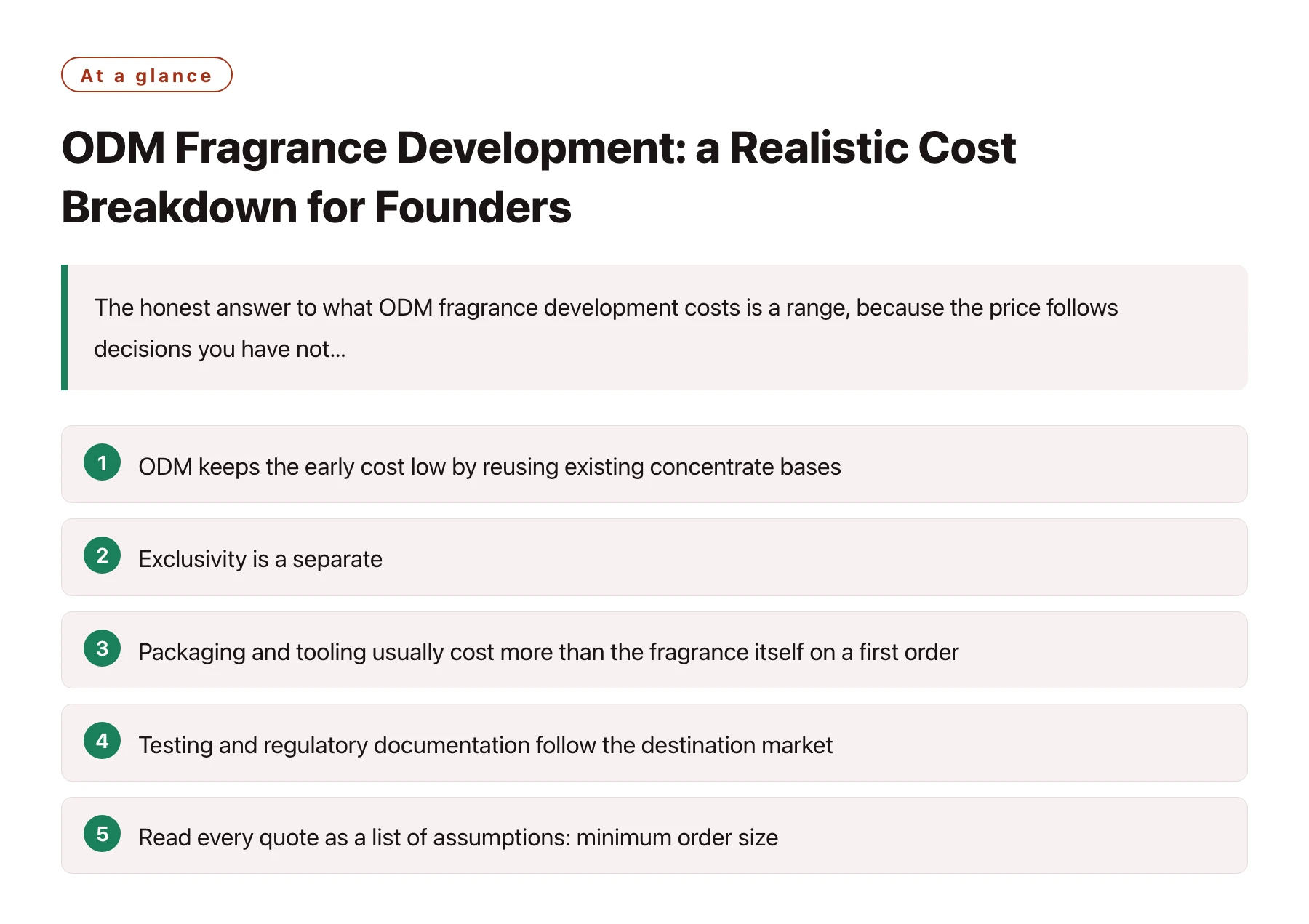
Key takeawaysODM keeps the early cost low by reusing existing concentrate bases, but a low entry price does not mean a small total bill — tooling, testing and exclusivity dominate. · Exclusivity is a separate, negotiable line item; assume shared development by default and buy exclusivity only where the scent is your differentiator. · Packaging and tooling usually cost more than the fragrance itself on a first order, so compare those numbers honestly across suppliers. · Testing and regulatory documentation follow the destination market, not the factory; budget them per market, and use the same compliance rules when comparing quotes. · Read every quote as a list of assumptions: minimum order size, fill size, included sample rounds, and what changes when you alter one variable.
Ask ten manufacturers for an ODM quote and you will get ten differently shaped documents, because the line items are not standardised. Some roll development into the unit price, some bill it separately, and some quote exclusive bases while others charge for them later.
This article breaks the project into its real cost components so the next quote you receive can be translated into one comparable shape before you compare suppliers.
The cost structure, top to bottom
An ODM fragrance project has five cost layers: development and sampling, the concentrate per unit, exclusivity, packaging and tooling, and testing and compliance. The first is a one-time project cost; the second recurs per bottle; the rest are paid once but sized by your choices.
Development and sampling covers the perfumer's work in building a trial from existing accords and adjusting it to your brief. In ODM this is cheaper than custom development because the building blocks already exist — which is exactly why ODM fragrance development attracts a first product: the economics assume reuse, and reuse is what keeps the first-order bill down.
Where the money goes
| Cost layer | What you pay for | What moves the number |
|---|---|---|
| Development and sampling | Perfumer time, materials, iterations to your brief | Rounds of revision, category complexity, material prices |
| Concentrate per unit | The fragrance oil in each bottle | Perfume concentration percentage, raw material price, volume |
| Exclusivity | The right to keep a base out of competitors' lines | Whether you pay it, and for which markets |
| Tooling and moulds | Bottle mould, cap mould, decoration plates | Whether existing packaging formats can be reused |
| Packaging materials | Bottle, cap, label, carton, outer case | Materials, decoration, minimum order sizes |
| Testing and compliance | Stability, safety assessment, market notification | Destination market rules and the number of markets |
The bottom two rows are the ones founders underestimate. Nobody notices on day one that regulation is priced per market, and tooling is priced per mould.
The quiet cost drivers
The single biggest lever in an ODM budget is reuse. If the manufacturer's existing bottle, cap and base fit your concept, the first-order cost drops sharply; if everything must be made new, design and tooling are added on top. That is why working with a contract manufacturer that holds a broad stock of formats and accords can be cheaper than a smaller operation — reuse is the discount a contract manufacturer for perfume brands.
Exclusivity deserves its own line. An ODM base is shared unless you negotiate otherwise, and if the scent becomes your brand asset, ownership must be settled in writing. Industrial designs, for example, can be registered nationally or through the international route administered by WIPO, and registration is only useful if your brand, not the supplier, holds the rights [1].
Testing is not optional decoration. Stability testing and a safety assessment are part of placing cosmetics on most regulated markets; the EU cosmetics rulebook, for example, requires a safety assessment and pre-market notification before products may be sold [2]. Budget these per market you enter.
Sample rounds are where ODM quotes silently inflate. Find out how many revisions the quoted price includes and what a further round costs. Testing houses such as SGS publish the standard battery for cosmetics — stability, challenge testing, labelling review — which gives you the vocabulary for a precise testing quote instead of a vague one [3].
Turning three quotes into one comparison
- Fix the brief firstSame family, same concentration, same fill size, same destination market — variance anywhere else is your fault, not the suppliers'.
- Ask for the same line itemsDevelopment, per-unit concentrate, tooling, packaging, testing and minimum order size — demand the same six rows from everyone.
- Normalise the volume assumptionsQuotes at different minimums are not comparable; rescale unit price and tooling to the same order volume before you compare.
- Price the changes, not the startAsk each supplier what an extra sample round, a second market and a rush lead time cost — the delta is the durable signal.
Where private label fits in the same budget
If your plan is closer to private label than to adapted development, the cost shape changes: private label fragrance production typically removes the development line entirely, because you start from a finished base the factory already makes private label fragrance production. The trade is individuality, and the decision is a budget question more than a quality question.
The rule that prevents ODM budget surprises: never sign a number, sign a structure. Six line items, each defined, with a unit and a quantity — everything else is negotiation material.
Sources
- WIPO — World Intellectual Property Organization —— The UN agency for intellectual property; resources on industrial design and patent protection relevant to product and packaging design.
- European Commission: Cosmetics in the EU —— The European Commission's overview of EU cosmetics rules, including the responsible person, product information file and safety report requirements.
- SGS: Cosmetics, Personal Care & Household Testing —— Testing, inspection and certification services for cosmetics and personal care, including microbiological, stability and safety testing aligned with cosmetics GMP.
Frequently asked questions
Is ODM perfume development cheaper than OEM?
Usually for the first product, because ODM reuses existing bases and formats while OEM bills you for building to your own specification. Over time the comparison depends on volume, exclusivity and how much you would otherwise pay a perfumer directly.
How much does fragrance exclusivity cost?
There is no fixed figure; it depends on the category, the markets and the manufacturer's policy. Treat it as a negotiable line item and get it in writing before the formula is finalised.
Are samples free in ODM?
Usually the first trial is included and revisions are billed after a defined number of rounds. Confirm the included rounds in writing, because free samples is the phrasing that hides the policy.
Do I pay for tooling even if I use existing packaging?
No — that is the point of ODM reuse. Tooling only appears when you want a bespoke bottle, cap or decoration. Asking to use existing formats is the fastest way to protect the first-order budget.
Why does testing cost so much for a small line?
The cost is mostly fixed: stability studies take time in the lab and the safety assessment is per-formula work. The number of units you sell does not change the test battery, which is why per-market testing is a budget line rather than an afterthought.
Authenticated. Shipped fast. Trusted by 2.4M+.
Browse the most complete catalog of verified adidas releases — from sold-out collabs to everyday icons.