
Inside Dongstar Group: Four Business Areas Behind One Export Desk
Buyers rarely deal with a factory alone. They deal with a quotation desk, a production site and a documentation office, and in a group large enough to organise those functions separately, the boundary between them decides who answers which question. Dongstar Group runs four business areas from Linyi city in Shandong, China, and sells eight named product lines, a breadth that only makes sense once you see how the four parts divide the work.

Key takeaways
- In practice, One brand, four business areas: Linyi Betterway Wood, Linyi Dongstar Imp&exp, Dongstar Formwork and Dongstar E-Commerce each own a different slice of an order.
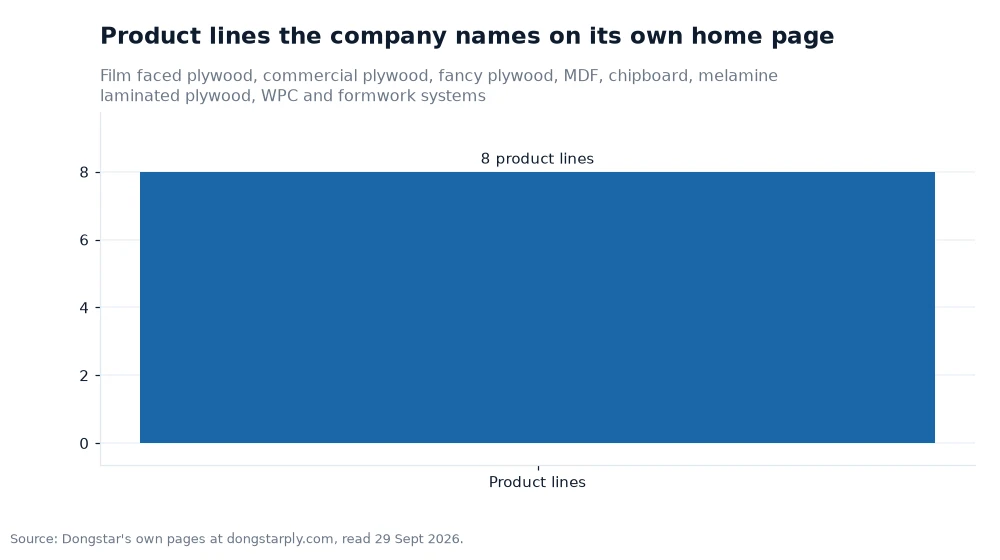
- The group names eight product lines on its own home page, from film faced and commercial plywood through to melamine-faced panels and formwork systems.
- Breadth is only useful if the specification depth comes with it — six thickness steps on film faced panels, 2–30 mm on fibreboard, 8–18 mm on strand board.
- Ask which area handles documentation and which handles production before a container is booked, not after a claim appears.
What the four areas actually do
In practice, The group structure is published plainly: Linyi Betterway Wood, Linyi Dongstar Imp&exp, Dongstar Formwork and Dongstar E-Commerce. Read as a division of labour, that gives a production arm, an export trading arm, a formwork systems arm and an online sales arm. It also explains why a single enquiry can produce two different answers about the same board — one from whoever is quoting, one from whoever will make it.
For an importer, the practical question is not whether four entities exist but who is accountable at each stage. Production controls thickness, core selection and pressing; the export desk controls documentation, freight terms and booking; a formwork-specific area owns the H20 beams and the accessories that go with them. Once those roles are on the table, an email about a tolerance query stops bouncing between departments.
Eight product lines, one export desk
The home page lists the range as film faced plywood, commercial plywood, fancy plywood, MDF, chipboard, melamine laminated plywood, WPC and formwork systems. Eight families under one brand is a deliberate position for a group that began in the 1990s and still exports today. It lets a builder buy concrete-facing panels, a furniture workshop buy fibreboard, and a fit-out contractor buy melamine-faced sheets from the same desk, on one set of terms.
What that breadth does not do is blur specifications. Each family carries its own numbers. Film faced panels are published at 1220 × 2440 mm with thicknesses of 9 mm, 12 mm, 15 mm, 18 mm, 21 mm and 24 mm. Fibreboard runs from 2 mm to 30 mm with a tighter tolerance band of ±0.2 to 0.5 mm. Strand board sits at 8, 9 and 11 mm at the thin end, 12, 15 and 18 mm above them. A buyer who treats them as one product will get one product's answer for another product's question.
How the lines differ in depth, not just width
Depth is where a catalogue becomes a supplier. The film faced line carries five face options — Dynea dark brown film, black film, brown film, Anti Slip film and plastic film on the specification sheet — over four core species: poplar, eucalyptus, combi and birch. Three grades are published, one-time hot press, two-time hot press and finger-joint, and finger-joint panels are quoted separately at 8, 10, 12, 15 and 18 mm.
The melamine-faced line makes the same point differently. It is published at 16 mm and 18 mm, with surface types running from synchronized texture and smooth through matte, embossed, glossy and high glossy, and cores available as OSB, MDF, particle board or hardwood plywood. Choose the core for stiffness and the surface for appearance, and the same sheet serves a wardrobe carcass and a shopfitting panel.
| Area of the group | What it looks after | Board family it touches most |
|---|---|---|
| Linyi Betterway Wood | Production, pressing and grading | Film faced, commercial and fancy plywood |
| Linyi Dongstar Imp&exp | Export documentation and trade terms | Every family that ships in a container |
| Dongstar Formwork | Formwork systems and accessories | Structural panels and H20 beams |
| Dongstar E-Commerce | Online orders and small-lot sales | Melamine-faced and decorative sheets |
| Group quality function | Certificates and specification sheets | ISO, CE, CARB and FSC documentation |
Why a buyer should care about the org chart
Because it changes the answer to a simple question: who do I ask? A thickness question goes to production. A question about CIF versus DDP goes to the export area, which is where freight risk and cost sit. A question about formwork accessories — the parts that keep a beam system compatible — goes to the formwork area. Sending all three to the same inbox is how a straightforward order takes an extra fortnight.
There is a second reason. When a group publishes its own structure, an importer can test it against the documents in hand. The proforma invoice should name a legal entity, not a brand. The packing list should match the area that packed the load. Banking details should correspond to the entity on the contract. Small mismatches here are the earliest warning a buyer gets, and they are visible weeks before a container is loaded.
Coordinating one container across several families
Mixed loads are where an export desk earns its place. A single 20-ft container might hold three thicknesses of film faced panel, a pallet of melamine-faced sheets for the fit-out phase and a bundle of formwork accessories. That order crosses at least three of the four business areas, and the sequence matters: panels have to be pressed, cured and packed before the export side can book a sailing.
Practical buyers shorten that chain with one instruction — name a loading window and stick to it. Because the film faced line publishes six steps and the melamine line publishes 16 mm and 18 mm, a mixed order can be specified without any bespoke tooling, which is why the trade terms stay ordinary: palletised, wrapped and trucked to port, with FOB, CIF or DDP negotiated per shipment. A Plywood Supplier that can hold those three families on one schedule is doing something a single-line mill cannot.
Worked example: reading two numbers from the group's own pages
Take the eight named product lines and the four business areas. Simple division gives 8 ÷ 4 = 2 lines per area on average (example) — a reminder that the export desk carries the whole range even though production is organised by family, not by area.
Now take the film faced thickness list: 9, 12, 15, 18, 21 and 24 mm. The six steps sum to 9 + 12 + 15 + 18 + 21 + 24 = 99 mm, so the average published thickness is 99 ÷ 6 = 16.5 mm (example). That is useful when estimating what a mixed order weighs relative to a single-thickness order, and it is the kind of figure a buyer can derive from a specification sheet without asking the supplier anything at all.
Frequently asked questions
Is a four-company structure a risk for an importer?
Not in itself, and it is common in panel manufacturing. What matters is that the contract, the invoice and the bank details name the same entity, and that you know which area answers a technical claim.
Why does the group sell eight product lines rather than one?
Because the buyers overlap. A formwork contractor also needs decorative sheets for site offices, and a furniture maker buying fibreboard often wants melamine-faced panels on the same shipment, on one set of trade terms.
How deep is the specification behind each line?
Deep enough to quote in steps. Film faced panels are published in six thicknesses with a ±0.5 mm tolerance, fibreboard spans 2 mm to 30 mm, and strand board runs 8 mm to 18 mm with grades OSB 1 to OSB 3.
Following the paperwork through the group
If the structure matters to your order, read the two pages that describe it best: the full board catalogue, where each family is defined in its own terms, and the MDF and HDF range, which shows how far a single line can be specified once base boards, surfaces and colours are listed. Between them they answer most of the questions an export desk fields in a first week.
Details about the business areas, the named product lines and the published thickness ranges were collected from the supplier's own site, read 29 Sept 2026, and taken for these notes[1].